Skip to Content

Data Analytics

Data Analytics is about turning business data into information people can understand, trust, and use to make better decisions.

Most organisations already generate significant amounts of data through their operational systems, customer interactions, financial platforms, spreadsheets, sales activity, websites, branches, suppliers, and internal processes. The challenge is rarely a lack of data. The challenge is bringing that information together and turning it into something useful.

CBOS helps organisations collect, structure, connect, analyse, and visualise their data so that decision-makers can understand what is happening across the business and act on that information with greater confidence.

From management dashboards and operational reporting to consolidated data platforms, automated reporting, trend analysis, and advanced analytics, we create data solutions designed around the questions your organisation needs answered.

“Data is absolutely critical for the effective running of I&J’s operations. CBOS were instrumental in creating a reliable solution for us. Their innovation and expertise in creating technically advanced solutions are impressive.”

I&J Fishing Company Logo
Robert Landman
Business Insights Manager, I&J Fishing Company

Data Analytics

Data Analytics is about turning business data into information people can understand, trust, and use to make better decisions.

Most organisations already generate significant amounts of data through their operational systems, customer interactions, financial platforms, spreadsheets, sales activity, websites, branches, suppliers, and internal processes. The challenge is rarely a lack of data. The challenge is bringing that information together and turning it into something useful.

CBOS helps organisations collect, structure, connect, analyse, and visualise their data so that decision-makers can understand what is happening across the business and act on that information with greater confidence.

From management dashboards and operational reporting to consolidated data platforms, automated reporting, trend analysis, and advanced analytics, we create data solutions designed around the questions your organisation needs answered.

“Data is absolutely critical for the effective running of I&J’s operations. CBOS were instrumental in creating a reliable solution for us. Their innovation and expertise in creating technically advanced solutions are impressive.”

I&J Fishing Company Logo
Robert Landman
Business Insights Manager, I&J Fishing Company
Data Analytics Breakdown

Key aspects of our Data Analytics


Trusted Data

Analytics is only as useful as the information behind it. CBOS helps identify, connect, clean, structure, and consolidate data from different sources so that reporting is based on information people can trust rather than conflicting spreadsheets or disconnected systems.


End-to-End Delivery

Data should make decisions easier, not create more complexity. We design dashboards, reports, measures, and analytical views around the questions people actually need answered, helping users quickly understand performance, trends, exceptions, and opportunities.


Built for Action

Good analytics should lead to action. CBOS connects reporting to real operational requirements so that information can highlight where attention is needed, measure progress, identify emerging issues, and help teams make more informed decisions across the organisation.

Key aspects of our Data Analytics


Trusted Data

Analytics is only as useful as the information behind it. CBOS helps identify, connect, clean, structure, and consolidate data from different sources so that reporting is based on information people can trust rather than conflicting spreadsheets or disconnected systems.


End-to-End Delivery

Data should make decisions easier, not create more complexity. We design dashboards, reports, measures, and analytical views around the questions people actually need answered, helping users quickly understand performance, trends, exceptions, and opportunities.


Built for Action

Good analytics should lead to action. CBOS connects reporting to real operational requirements so that information can highlight where attention is needed, measure progress, identify emerging issues, and help teams make more informed decisions across the organisation.

The Pain Point

Businesses often have plenty of data but struggle to turn it into one reliable view of what is happening.

Information is created throughout an organisation every day.

Sales systems capture transactions. Customer platforms record interactions. Finance systems manage revenue and costs. Operational applications track activity. Websites generate digital data. Branches maintain local records. Teams create spreadsheets and reports.

Yet management may still struggle to answer relatively simple questions.

  • How are we performing?
  • Where are we falling behind?
  • Which products, customers, branches, or regions are driving the result?
  • What has changed?
  • Why has it changed?
  • Where should we focus next?

The problem is often that the answers sit across several different systems.

One department may report one number while another produces something different. Reports may require hours of manual preparation every week or month. Employees export data into Excel, manipulate it manually, combine information from several sources, and distribute static reports that are already out of date by the time someone reads them.

Over time, this creates uncertainty around which numbers are correct and makes it harder for people to identify what actually matters.


The challenge is not simply collecting more data. It is creating a reliable, connected view of the information the business already has and turning it into insight people can act on.

What CBOS Offers

We transform fragmented business information into connected analytics, reporting, and management insight.


CBOS approaches analytics from the business question backwards.

We begin by understanding what people need to know.

What does management need visibility over? Which measures actually indicate whether the business is performing? Where does the underlying information currently come from? Which reports take too much time to prepare? Where are people relying on spreadsheets? Which numbers are disputed? What decisions would improve if the right information were available sooner?

Once those questions are clear, we determine how the data needs to be collected, connected, structured, and presented.

This may involve bringing together information from several business systems, developing a central data environment, automating reporting, creating operational dashboards, introducing management scorecards, or building analytical capabilities directly into an existing application.

The objective is not to create dashboards simply because data exists.

It is to give the organisation a clearer understanding of what is happening and why.


CBOS helps move organisations from: “We need to gather the information before we can answer that.”

to: “We can see what is happening and investigate it immediately.”

How it Works

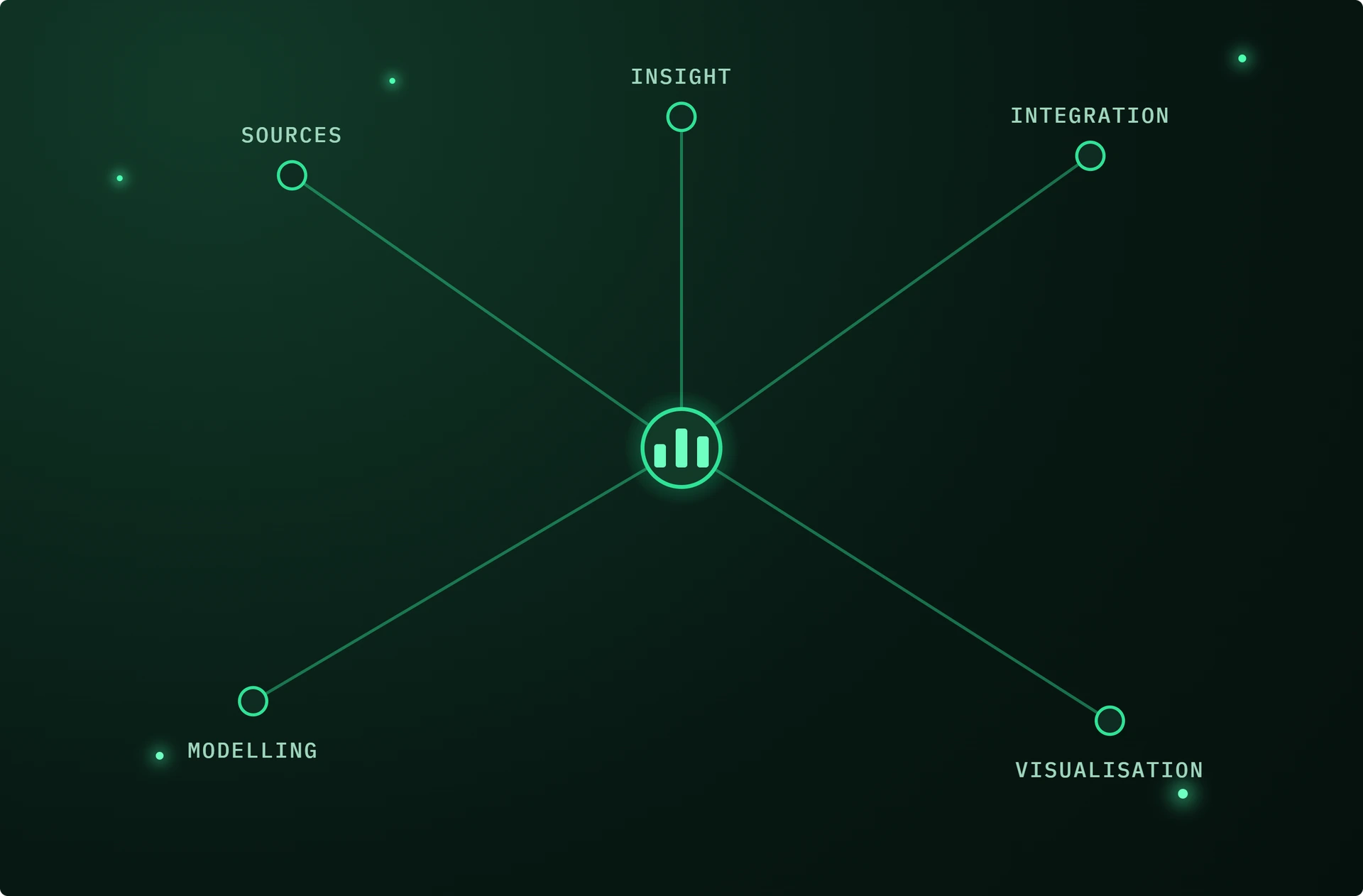
We move from understanding the decisions you need to make to creating a reliable and accessible analytics environment.

Bespoke development starts with understanding the business before deciding what technology should be built.

Understand

We work with stakeholders to understand how the organisation operates, what information is already available, how reporting currently happens, and where better insight could improve decision-making.

This prevents analytics from becoming an exercise in simply displaying everything that can be measured.

The objective is to identify the information that matters, the questions users need answered, and the relationships between different areas of the business.

Connect

Most analytics environments depend on more than one source of information.


Depending on the organisation, data may come from:

  • ERP, CRM, and accounting platforms
  • Operational and bespoke applications
  • Point-of-sale and transactional systems
  • Websites and digital platforms
  • Customer and supplier systems
  • Spreadsheets and structured files
  • Cloud services and external APIs
  • Existing databases and data platforms

CBOS creates the connections required to bring this information together in a controlled and repeatable way.

Where possible, this removes the need for employees to repeatedly export, copy, reconcile, and combine information manually.

Structure

Connecting data is only part of the challenge.

Different systems may describe the same customer, product, region, transaction, or performance measure in different ways. Data may contain duplicates, missing values, inconsistent formats, or different business definitions.

CBOS structures the information so that the analytics environment reflects how the organisation actually thinks about the business.

This creates a stronger foundation for consistent reporting and allows different users to work from the same underlying view of the organisation.

Analyse

Once the information is reliable, we build the analytical logic that turns raw data into something useful.

This may include performance measures, comparisons against targets, period-on-period trends, segmentation, regional analysis, customer behaviour, product performance, operational efficiency, exceptions, forecasting inputs, or other measures specific to the organisation.

Analytics can move progressively from showing what happened to helping explain why it happened and where attention may be required.

Visualise

Information should be presented differently depending on who is using it.

An executive may need a concise view of overall business performance. A regional manager may need to compare locations. An operations team may need detailed daily activity. A finance user may need to investigate specific transactions.


Analytics solutions can include:

  • Executive and management dashboards
  • Operational reporting
  • Performance scorecards
  • Branch and regional comparisons
  • Trend and variance analysis
  • Interactive drill-down reporting
  • Automated scheduled reports
  • Analytics embedded into business applications

The objective is to provide enough information to make the position clear while still allowing users to investigate the detail when necessary.

Evolve

Reporting requirements change as the organisation changes.

New systems are introduced. New products become important. Management wants to measure different outcomes. Data becomes available that did not exist before.

CBOS can continue extending the data environment, introducing new measures and sources while ensuring that the underlying analytics architecture remains manageable and consistent.

A strong data foundation can also create the basis for more advanced analytics, automation, predictive modelling, and artificial intelligence in the future.

What We Can Deliver

Data solutions ranging from operational dashboards to consolidated management and enterprise analytics environments.

For one organisation, the requirement may be relatively simple: eliminate a collection of manually maintained Excel reports and provide management with one live dashboard.

For another, the challenge may involve information spread across dozens of systems, locations, or business units that needs to be consolidated into a common reporting environment.

CBOS can develop executive dashboards, operational reporting platforms, branch and regional reporting, customer and product analytics, sales performance reporting, supplier analysis, financial and commercial dashboards, management scorecards, and specialised analytical applications.

Analytics can also be built directly into bespoke software, allowing users to see relevant information while they are performing their day-to-day work rather than requiring them to move into a separate reporting environment.

Where the requirement becomes more advanced, the same data foundation can support forecasting, predictive analytics, anomaly detection, machine learning, and AI-enabled decision support.

The solution is driven by the information the organisation needs rather than by a particular reporting product.

Why it Matters

Better access to reliable information helps people make faster decisions with greater confidence and less manual effort.

Businesses make decisions continuously.

Some are strategic. Others happen thousands of times every day across operations, sales, finance, customer service, procurement, and management.

The quality of those decisions depends heavily on the information available at the time.

If the information is incomplete, delayed, inconsistent, or difficult to access, people either spend time finding it or make decisions without it.

A well-designed analytics environment changes that.

Management can see performance without waiting for someone to compile a report. Teams can identify exceptions before they become larger problems. Branches can compare their performance with the wider organisation. Trends become visible sooner. The reasons behind a result can be investigated instead of debated.

It also reduces the amount of time skilled employees spend preparing information for other people.


Good analytics shortens the distance between something happening in the business and someone understanding what it means.

When Analytics Makes Sense

Analytics becomes particularly valuable when important decisions depend on information spread across different systems or teams.

Most organisations can benefit from better analytics, but the need becomes especially clear when reporting starts requiring significant manual effort.

If important management information is maintained in spreadsheets, if different departments produce conflicting numbers, if reports only become available days or weeks after the period ends, or if managers cannot easily investigate what is driving a result, the reporting environment is creating unnecessary friction.

Analytics is also valuable when an organisation grows.

A business that once relied on experienced managers knowing what was happening can become much harder to understand once it operates across many products, customers, branches, systems, or regions.

The right data environment creates visibility at scale.

It allows leaders to understand the organisation as a whole while still being able to investigate the detail behind individual areas of performance.

Example Use Cases

Practical examples of how connected data can improve visibility, reporting, and decision-making across an organisation.

A Management Team


“Every department gives us a different version of the numbers.”

CBOS can create a consolidated management environment where agreed measures are calculated consistently from the underlying business data.

Leadership gains a common view of performance while still being able to drill into individual business areas when required.

An Operations Team


“We spend hours every week putting the same reports together.”

CBOS can automate the movement and preparation of the underlying information so that operational dashboards update without employees repeatedly rebuilding reports.

The team spends less time preparing data and more time responding to what the data shows.

A Multi-Branch Business


“We can see the total, but we cannot easily understand how each branch is performing.”

CBOS can provide national, regional, and branch-level analytics within the same reporting environment.

Management can compare locations, identify strong and weak performers, understand trends, and investigate the underlying operational measures driving the result.

A Sales Organisation


“We know our total sales, but not enough about what is driving them.”

Analytics can reveal how revenue is distributed across products, customers, locations, channels, or salespeople and how those patterns change over time.

This gives management a clearer understanding of where growth is coming from and where performance may require attention.

A Customer-Focused Business


“Customer information exists in several systems and we never see the complete picture.”

CBOS can connect information from different customer touchpoints to create a more complete analytical view.

This can help the organisation understand engagement, behaviour, service activity, purchasing patterns, and other measures relevant to the customer relationship.

A Growing Organisation


“Our reporting works today, but it will not scale with the business.”

CBOS can build a structured data environment that supports current reporting while creating a foundation for future analysis.

As the organisation grows, new systems, data sources, predictive models, or AI capabilities can be connected to that same foundation.

One View of the Business

Bring information from across the organisation together so that people work from a shared understanding of performance.

A major challenge in analytics is not the individual report.

It is consistency.

When teams create their own spreadsheets and calculations, different interpretations of the same measure naturally begin to appear.

What qualifies as an active customer? Which date determines the reporting period? How should revenue be attributed? What counts towards a target? How are cancellations handled?

These may sound like reporting questions, but they are actually business-definition questions.

CBOS helps embed agreed definitions into the underlying analytics logic so that people are not repeatedly debating how a number was calculated.

The objective is to create a common analytical language across the organisation.

Designed to Connect

Analytics becomes more valuable when information from different systems can be understood as part of one business story.

The most useful insights often do not exist within a single application.

Sales information may become more meaningful when combined with customer activity. Operational performance may need to be compared with financial outcomes. Marketing activity may need to be connected to enquiries, sales, or customer behaviour.

CBOS connects information across the wider technology environment so that these relationships can become visible.

This creates analytics that reflect the organisation rather than the structure of an individual software system.

From the user's perspective, they see one coherent view even though the underlying information may come from many different places.

Future-Proof

Build a strong data foundation that can support more advanced analytics, automation, prediction, and AI over time.

Data analytics is increasingly becoming the foundation for broader digital capability.

  • Before a business can reliably predict what might happen, it needs to understand what has already happened.
  • Before AI can reason over operational information, that information needs to be accessible and meaningful.
  • Before processes can become more intelligent, the organisation needs reliable data about how those processes are performing.

A well-designed analytics environment therefore creates value beyond dashboards and reporting.

It gives the organisation a structured information foundation from which more advanced capabilities can develop.

Business Impact

Reliable analytics improves visibility, reduces reporting effort, and helps organisations respond to performance more quickly.

The most immediate impact is often time.

Reports that previously required hours or days of manual preparation can become automatically available. Employees stop repeatedly manipulating the same information. Management no longer has to wait for someone to assemble the numbers before understanding what has happened.

But the larger value comes from better decisions.

Problems can be identified sooner. Performance can be compared objectively. Management discussions can focus on what needs to happen rather than which spreadsheet is correct. Opportunities that might otherwise remain hidden become easier to recognise.

As the quality of the data environment improves, confidence in the organisation's information improves with it.

That confidence creates a stronger basis for operational management, strategic planning, automation, and future AI initiatives.


The objective is not more reports. It is a better-informed organisation.

The Pain Point

Businesses often have plenty of data but struggle to turn it into one reliable view of what is happening.

Information is created throughout an organisation every day.

Sales systems capture transactions. Customer platforms record interactions. Finance systems manage revenue and costs. Operational applications track activity. Websites generate digital data. Branches maintain local records. Teams create spreadsheets and reports.

Yet management may still struggle to answer relatively simple questions.

  • How are we performing?
  • Where are we falling behind?
  • Which products, customers, branches, or regions are driving the result?
  • What has changed?
  • Why has it changed?
  • Where should we focus next?

The problem is often that the answers sit across several different systems.

One department may report one number while another produces something different. Reports may require hours of manual preparation every week or month. Employees export data into Excel, manipulate it manually, combine information from several sources, and distribute static reports that are already out of date by the time someone reads them.

Over time, this creates uncertainty around which numbers are correct and makes it harder for people to identify what actually matters.


The challenge is not simply collecting more data. It is creating a reliable, connected view of the information the business already has and turning it into insight people can act on.

What CBOS Offers

We transform fragmented business information into connected analytics, reporting, and management insight.


CBOS approaches analytics from the business question backwards.

We begin by understanding what people need to know.

What does management need visibility over? Which measures actually indicate whether the business is performing? Where does the underlying information currently come from? Which reports take too much time to prepare? Where are people relying on spreadsheets? Which numbers are disputed? What decisions would improve if the right information were available sooner?

Once those questions are clear, we determine how the data needs to be collected, connected, structured, and presented.

This may involve bringing together information from several business systems, developing a central data environment, automating reporting, creating operational dashboards, introducing management scorecards, or building analytical capabilities directly into an existing application.

The objective is not to create dashboards simply because data exists.

It is to give the organisation a clearer understanding of what is happening and why.


CBOS helps move organisations from: “We need to gather the information before we can answer that.”

to: “We can see what is happening and investigate it immediately.”

How it Works

We move from understanding the decisions you need to make to creating a reliable and accessible analytics environment.

Bespoke development starts with understanding the business before deciding what technology should be built.

Understand

We work with stakeholders to understand how the organisation operates, what information is already available, how reporting currently happens, and where better insight could improve decision-making.

This prevents analytics from becoming an exercise in simply displaying everything that can be measured.

The objective is to identify the information that matters, the questions users need answered, and the relationships between different areas of the business.

Connect

Most analytics environments depend on more than one source of information.


Depending on the organisation, data may come from:

  • ERP, CRM, and accounting platforms
  • Operational and bespoke applications
  • Point-of-sale and transactional systems
  • Websites and digital platforms
  • Customer and supplier systems
  • Spreadsheets and structured files
  • Cloud services and external APIs
  • Existing databases and data platforms

CBOS creates the connections required to bring this information together in a controlled and repeatable way.

Where possible, this removes the need for employees to repeatedly export, copy, reconcile, and combine information manually.

Structure

Connecting data is only part of the challenge.

Different systems may describe the same customer, product, region, transaction, or performance measure in different ways. Data may contain duplicates, missing values, inconsistent formats, or different business definitions.

CBOS structures the information so that the analytics environment reflects how the organisation actually thinks about the business.

This creates a stronger foundation for consistent reporting and allows different users to work from the same underlying view of the organisation.

Analyse

Once the information is reliable, we build the analytical logic that turns raw data into something useful.

This may include performance measures, comparisons against targets, period-on-period trends, segmentation, regional analysis, customer behaviour, product performance, operational efficiency, exceptions, forecasting inputs, or other measures specific to the organisation.

Analytics can move progressively from showing what happened to helping explain why it happened and where attention may be required.

Visualise

Information should be presented differently depending on who is using it.

An executive may need a concise view of overall business performance. A regional manager may need to compare locations. An operations team may need detailed daily activity. A finance user may need to investigate specific transactions.


Analytics solutions can include:

  • Executive and management dashboards
  • Operational reporting
  • Performance scorecards
  • Branch and regional comparisons
  • Trend and variance analysis
  • Interactive drill-down reporting
  • Automated scheduled reports
  • Analytics embedded into business applications

The objective is to provide enough information to make the position clear while still allowing users to investigate the detail when necessary.

Evolve

Reporting requirements change as the organisation changes.

New systems are introduced. New products become important. Management wants to measure different outcomes. Data becomes available that did not exist before.

CBOS can continue extending the data environment, introducing new measures and sources while ensuring that the underlying analytics architecture remains manageable and consistent.

A strong data foundation can also create the basis for more advanced analytics, automation, predictive modelling, and artificial intelligence in the future.
What We Can Deliver

Data solutions ranging from operational dashboards to consolidated management and enterprise analytics environments.

For one organisation, the requirement may be relatively simple: eliminate a collection of manually maintained Excel reports and provide management with one live dashboard.

For another, the challenge may involve information spread across dozens of systems, locations, or business units that needs to be consolidated into a common reporting environment.

CBOS can develop executive dashboards, operational reporting platforms, branch and regional reporting, customer and product analytics, sales performance reporting, supplier analysis, financial and commercial dashboards, management scorecards, and specialised analytical applications.

Analytics can also be built directly into bespoke software, allowing users to see relevant information while they are performing their day-to-day work rather than requiring them to move into a separate reporting environment.

Where the requirement becomes more advanced, the same data foundation can support forecasting, predictive analytics, anomaly detection, machine learning, and AI-enabled decision support.

The solution is driven by the information the organisation needs rather than by a particular reporting product.


Why it Matters

Better access to reliable information helps people make faster decisions with greater confidence and less manual effort.

Businesses make decisions continuously.

Some are strategic. Others happen thousands of times every day across operations, sales, finance, customer service, procurement, and management.

The quality of those decisions depends heavily on the information available at the time.

If the information is incomplete, delayed, inconsistent, or difficult to access, people either spend time finding it or make decisions without it.

A well-designed analytics environment changes that.

Management can see performance without waiting for someone to compile a report. Teams can identify exceptions before they become larger problems. Branches can compare their performance with the wider organisation. Trends become visible sooner. The reasons behind a result can be investigated instead of debated.

It also reduces the amount of time skilled employees spend preparing information for other people.


Good analytics shortens the distance between something happening in the business and someone understanding what it means.

When Analytics Makes Sense

Analytics becomes particularly valuable when important decisions depend on information spread across different systems or teams.

Most organisations can benefit from better analytics, but the need becomes especially clear when reporting starts requiring significant manual effort.

If important management information is maintained in spreadsheets, if different departments produce conflicting numbers, if reports only become available days or weeks after the period ends, or if managers cannot easily investigate what is driving a result, the reporting environment is creating unnecessary friction.

Analytics is also valuable when an organisation grows.

A business that once relied on experienced managers knowing what was happening can become much harder to understand once it operates across many products, customers, branches, systems, or regions.

The right data environment creates visibility at scale.

It allows leaders to understand the organisation as a whole while still being able to investigate the detail behind individual areas of performance.

Example Use Cases

Practical examples of how connected data can improve visibility, reporting, and decision-making across an organisation.

A Management Team


“Every department gives us a different version of the numbers.”

CBOS can create a consolidated management environment where agreed measures are calculated consistently from the underlying business data.

Leadership gains a common view of performance while still being able to drill into individual business areas when required.

An Operations Team


“We spend hours every week putting the same reports together.”

CBOS can automate the movement and preparation of the underlying information so that operational dashboards update without employees repeatedly rebuilding reports.

The team spends less time preparing data and more time responding to what the data shows.

A Multi-Branch Business


“We can see the total, but we cannot easily understand how each branch is performing.”

CBOS can provide national, regional, and branch-level analytics within the same reporting environment.

Management can compare locations, identify strong and weak performers, understand trends, and investigate the underlying operational measures driving the result.

A Sales Organisation


“We know our total sales, but not enough about what is driving them.”

Analytics can reveal how revenue is distributed across products, customers, locations, channels, or salespeople and how those patterns change over time.

This gives management a clearer understanding of where growth is coming from and where performance may require attention.

A Customer-Focused Business


“Customer information exists in several systems and we never see the complete picture.”

CBOS can connect information from different customer touchpoints to create a more complete analytical view.

This can help the organisation understand engagement, behaviour, service activity, purchasing patterns, and other measures relevant to the customer relationship.

A Growing Organisation


“Our reporting works today, but it will not scale with the business.”

CBOS can build a structured data environment that supports current reporting while creating a foundation for future analysis.

As the organisation grows, new systems, data sources, predictive models, or AI capabilities can be connected to that same foundation.

One View of the Business

Bring information from across the organisation together so that people work from a shared understanding of performance.

A major challenge in analytics is not the individual report.

It is consistency.

When teams create their own spreadsheets and calculations, different interpretations of the same measure naturally begin to appear.

What qualifies as an active customer? Which date determines the reporting period? How should revenue be attributed? What counts towards a target? How are cancellations handled?

These may sound like reporting questions, but they are actually business-definition questions.

CBOS helps embed agreed definitions into the underlying analytics logic so that people are not repeatedly debating how a number was calculated.

The objective is to create a common analytical language across the organisation.

Designed to Connect

Analytics becomes more valuable when information from different systems can be understood as part of one business story.

The most useful insights often do not exist within a single application.

Sales information may become more meaningful when combined with customer activity. Operational performance may need to be compared with financial outcomes. Marketing activity may need to be connected to enquiries, sales, or customer behaviour.

CBOS connects information across the wider technology environment so that these relationships can become visible.

This creates analytics that reflect the organisation rather than the structure of an individual software system.

From the user's perspective, they see one coherent view even though the underlying information may come from many different places.

Future-Proof

Build a strong data foundation that can support more advanced analytics, automation, prediction, and AI over time.

Data analytics is increasingly becoming the foundation for broader digital capability.

  • Before a business can reliably predict what might happen, it needs to understand what has already happened.
  • Before AI can reason over operational information, that information needs to be accessible and meaningful.
  • Before processes can become more intelligent, the organisation needs reliable data about how those processes are performing.

A well-designed analytics environment therefore creates value beyond dashboards and reporting.

It gives the organisation a structured information foundation from which more advanced capabilities can develop.

Business Impact

Reliable analytics improves visibility, reduces reporting effort, and helps organisations respond to performance more quickly.

The most immediate impact is often time.

Reports that previously required hours or days of manual preparation can become automatically available. Employees stop repeatedly manipulating the same information. Management no longer has to wait for someone to assemble the numbers before understanding what has happened.

But the larger value comes from better decisions.

Problems can be identified sooner. Performance can be compared objectively. Management discussions can focus on what needs to happen rather than which spreadsheet is correct. Opportunities that might otherwise remain hidden become easier to recognise.

As the quality of the data environment improves, confidence in the organisation's information improves with it.

That confidence creates a stronger basis for operational management, strategic planning, automation, and future AI initiatives.


The objective is not more reports. It is a better-informed organisation.

The CBOS Difference

Analytics projects often focus heavily on the visual dashboard.

CBOS looks beneath it.

We consider where the information originates, how reliable it is, how different systems define it, how frequently it needs to change, who should have access to it, and what decisions the organisation ultimately needs to make from it.

Our capabilities across bespoke software, systems integration, cloud infrastructure, data, automation, and artificial intelligence allow us to address the complete data journey rather than only the final visualisation.

Where necessary, we can improve how information is captured at source, connect previously isolated systems, create the underlying data platform, develop the analytical logic, and then deliver the information through the most appropriate interface.

The result is not simply a dashboard.

It is a data capability that becomes part of how the organisation understands and manages itself.

What you will get


  Trusted Data

  Clear Insight

  Better Decisions

Contact us

The CBOS Difference

Analytics projects often focus heavily on the visual dashboard.

CBOS looks beneath it.

We consider where the information originates, how reliable it is, how different systems define it, how frequently it needs to change, who should have access to it, and what decisions the organisation ultimately needs to make from it.

Our capabilities across bespoke software, systems integration, cloud infrastructure, data, automation, and artificial intelligence allow us to address the complete data journey rather than only the final visualisation.

Where necessary, we can improve how information is captured at source, connect previously isolated systems, create the underlying data platform, develop the analytical logic, and then deliver the information through the most appropriate interface.

The result is not simply a dashboard.

It is a data capability that becomes part of how the organisation understands and manages itself.

What you will get


  Trusted Data

  Clear Insight

  Better Decisions

Contact us

Connected

Data

Bring information together universally

Clear
Insight

Understand what is happening and why

Live 

Reporting

Replace manual reports with accessible information

Better 

Decisions

Turn reliable data into business action

Connected

Data

Bring information together universally

Clear
Insight

Understand what is happening and why

Live 

Reporting

Replace manual reports with accessible information

Better 

Decisions

Turn reliable data into business action

Let's Connect

Interested in building a smarter, more connected operation? Contact us to discuss how Data Analytics can support your business goals.

Let's Connect

Interested in building a smarter, more connected operation? Contact us to discuss how Data Analytics can support your business goals.