Bespoke development starts with understanding the business before deciding what technology should be built.
Assess
For an existing environment, we begin by understanding what is currently running and how the different components interact.
This includes the applications, databases, networks, integrations, security requirements, data, workloads, users, dependencies, current costs, and business-critical services.
For a new environment, we start with the solution architecture and determine what infrastructure will be required to support it reliably.
The objective is to understand both the technology and the business requirements behind it before determining the appropriate cloud architecture.
Architect
Once the requirements are clear, CBOS designs the architecture that will support them.
The architecture considers how workloads should be distributed, how applications communicate, where data should reside, how users and systems authenticate, how access should be controlled, how failures should be handled, and how the environment will scale as demand changes.
Depending on the requirement, the architecture can include:
- Compute, containers, and application services
- Networking, connectivity, and traffic management
- Databases, storage, and data services
- Identity and access management
- Security and perimeter controls
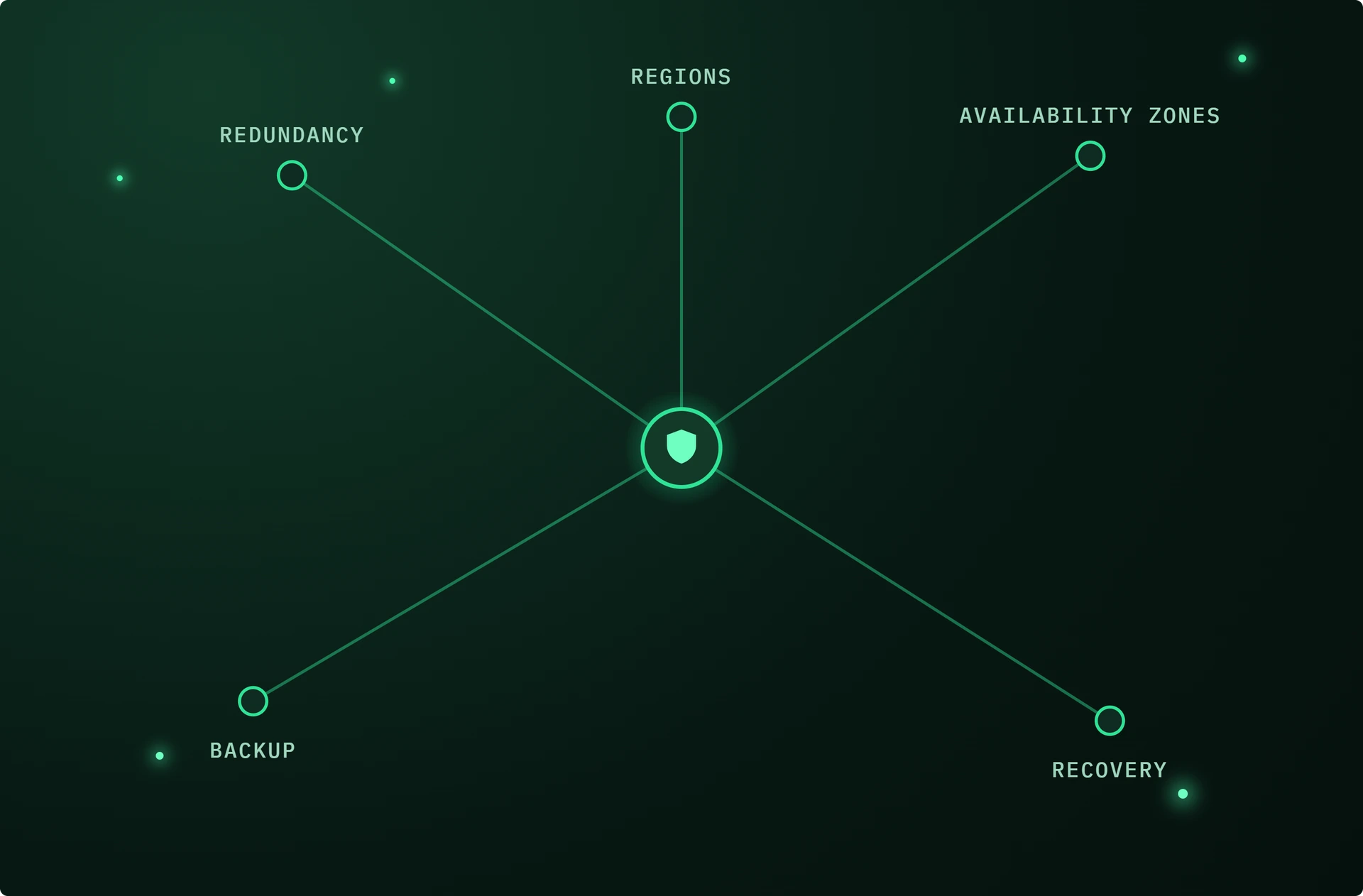
- High availability and geo-redundancy
- Backup and disaster recovery
- Monitoring, logging, and alerting
The objective is to create an architecture appropriate to the importance of the systems it supports rather than over-engineering or under-protecting the environment.
Automate
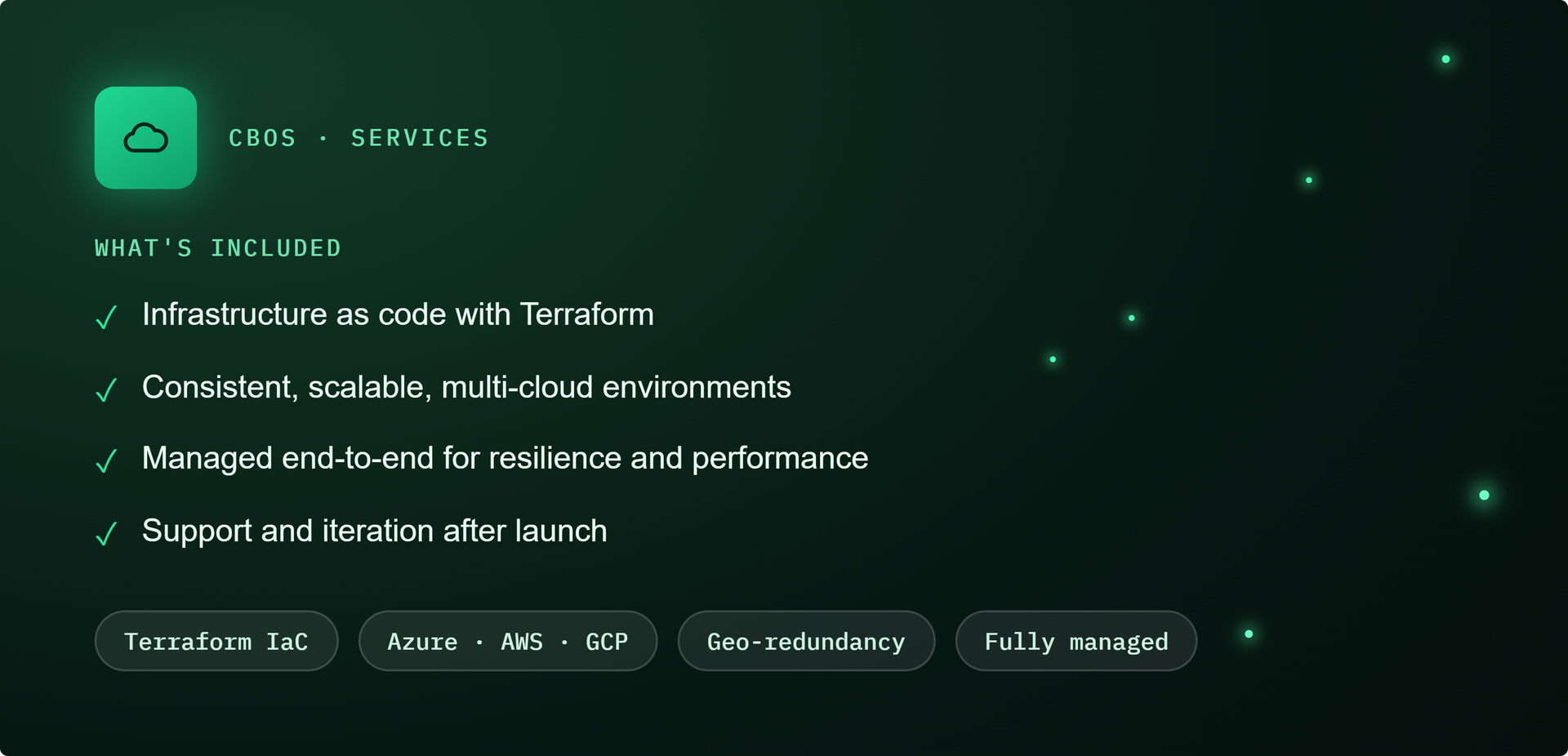
CBOS defines infrastructure through code wherever practical.
This means networks, services, resources, configurations, and environments can be deployed according to an agreed definition rather than someone manually recreating the same configuration each time.
Changes can be controlled and reviewed. Environments can be reproduced. Development, testing, staging, and production environments can follow the same underlying standards.
Infrastructure becomes part of the technology lifecycle rather than a collection of settings hidden inside a cloud console.
Deploy
For greenfield solutions, CBOS builds the new environment according to the agreed architecture.
For existing systems, the deployment may form part of a wider migration or modernisation programme. This can involve moving workloads, databases, applications, storage, integrations, or services into a new cloud architecture while managing dependencies and operational risk.
A migration can involve approaches such as:
- Moving existing workloads into cloud infrastructure
- Replatforming applications onto managed cloud services
- Modernising selected components while retaining others
- Moving from single-server to highly available architectures
- Migrating between cloud providers
- Creating hybrid or multi-cloud environments
- Moving applications progressively rather than all at once
- Building parallel environments before controlled cutover
The appropriate approach depends on the system, its age, business importance, architecture, and tolerance for disruption.
Protect
CBOS treats resilience and security as fundamental parts of the cloud architecture.
Access is controlled according to the requirements of the organisation. Services are monitored. Backups are automated. Recovery processes are defined and tested. Where appropriate, workloads can be distributed across availability zones or geographic regions to reduce dependency on a single infrastructure component or location.
The aim is not to claim that failure will never occur.
It is to design the environment so that individual failures do not unnecessarily become business failures.
Manage
Cloud infrastructure requires ongoing management.
Applications change. Security threats evolve. Resource requirements increase or decrease. New cloud services become available. Costs move. Operating systems and platforms need updating. Business continuity requirements change.
CBOS manages the environment continuously, monitoring infrastructure health, maintaining the underlying technology, reviewing capacity and performance, supporting deployments, addressing operational issues, and helping the architecture evolve as the organisation changes.
This allows internal teams to focus on the business and applications rather than the infrastructure beneath them.