Bespoke development starts with understanding the business before deciding what technology should be built.
Understand
We start by understanding the organisation, its objectives, processes, data, technology environment, users, and areas of operational friction.
Not every problem requires artificial intelligence.
Part of the process is determining where AI genuinely adds value and where conventional software, integration, automation, or process improvement may be the better solution.
The strongest AI opportunities usually emerge where large volumes of information need to be interpreted, patterns need to be identified, predictions need to be made, or employees repeatedly perform work that requires some level of judgement or understanding.
Design
Once the opportunity has been identified, we determine what intelligence the solution requires and how it should operate within the business.
Depending on the requirement, this can involve:
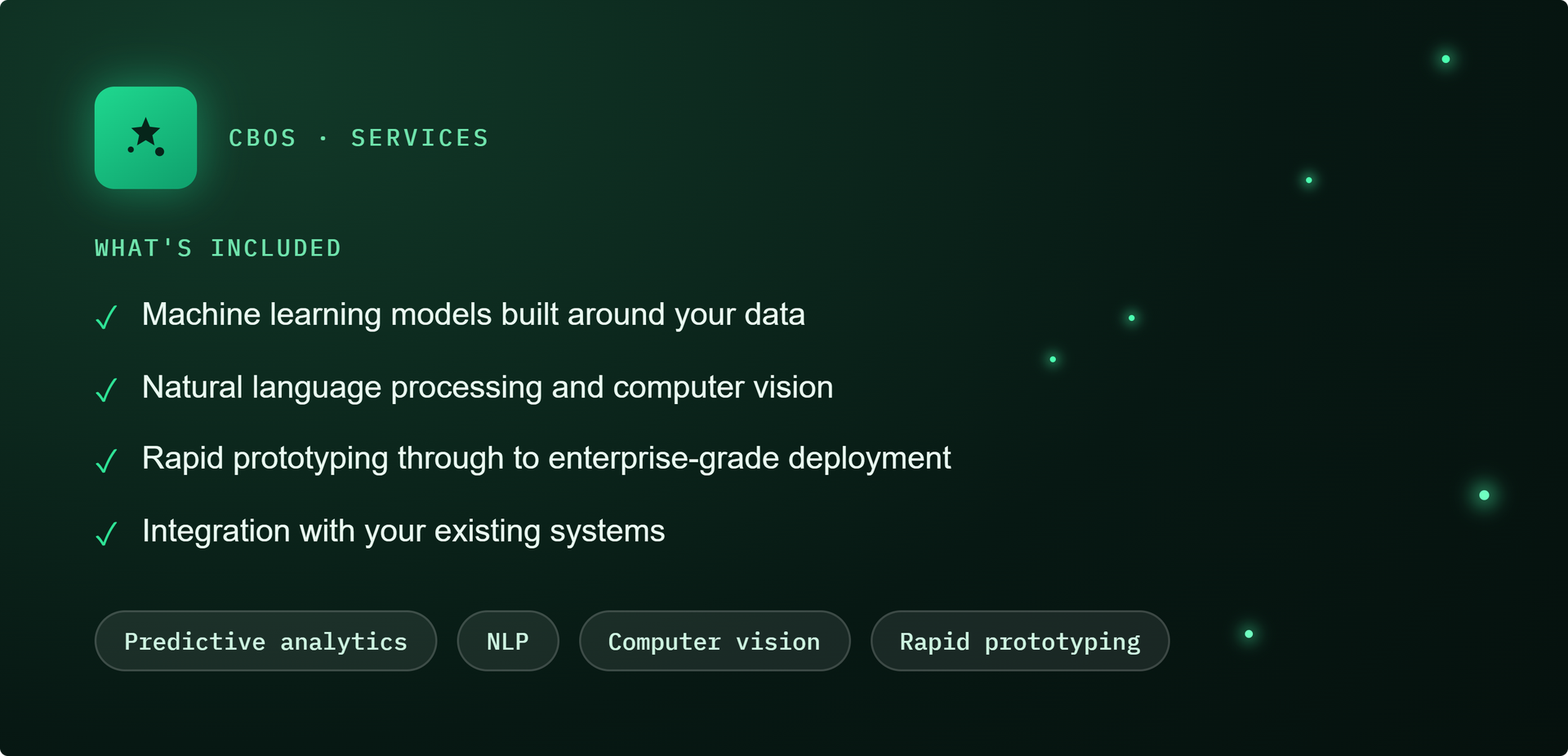
- Generative AI and large language models
- Natural language processing
- Predictive analytics and machine learning
- Computer vision and image analysis
- Intelligent document processing
- Recommendation and classification models
- AI-assisted search and retrieval
- Intelligent workflow and decision support
We also define where the required information comes from, how users will interact with the capability, what actions the AI may perform, and where human approval or oversight should remain.
Build
CBOS develops the applications, services, interfaces, workflows, and supporting technology required to turn the AI capability into a working solution.
In some cases, the AI itself is only a small part of the overall system.
A useful business solution may also require user interfaces, databases, APIs, workflow engines, permission structures, business rules, cloud infrastructure, reporting, and integrations.
This is why our broader software engineering capability is important. We can build the surrounding technology required to make AI genuinely usable.
Connect
AI becomes substantially more useful when it can interact with relevant business information and systems.
A solution may need to retrieve information, interpret it, make a recommendation, initiate a workflow, update another application, or return the result to an employee or customer.
AI solutions can connect with environments such as:
- Business applications and databases
- ERP and CRM platforms
- Document and knowledge repositories
- Microsoft 365 and collaboration environments
- Data platforms and reporting systems
- Customer and supplier platforms
- External services and APIs
- Bespoke and legacy applications
This creates the possibility for AI to move beyond simply answering questions and begin participating in real business processes.
Govern
AI needs appropriate controls around how information is accessed, how outputs are used, and what actions the technology is permitted to perform.
CBOS considers permissions, security, privacy, data boundaries, traceability, model behaviour, human oversight, and operational risk as part of the solution design.
The appropriate level of control depends on the use case.
An AI assistant helping someone find information requires different controls from an AI capability making recommendations or initiating actions within a business system.
Evolve
AI capabilities continue to improve as the technology, available data, and requirements of the organisation change.
A solution may begin by assisting employees with a particular task and later become more deeply integrated into the process as confidence, data quality, and business requirements develop.
CBOS can continue refining models, prompts, workflows, integrations, interfaces, and supporting software as the capability evolves.
This allows organisations to adopt AI progressively rather than attempting to transform everything at once.